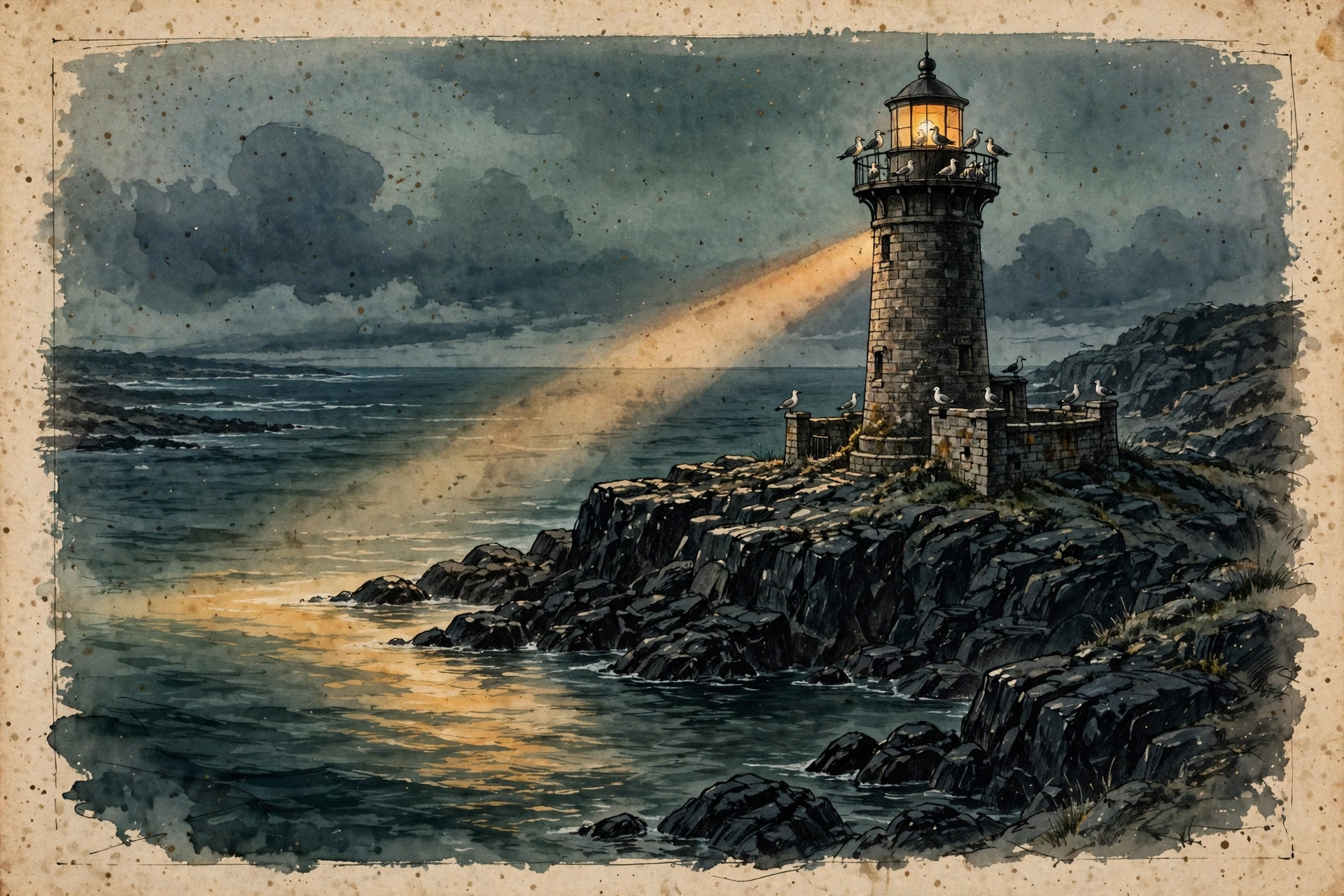
Opening · The Outgoing List
Accepted into the working draft after review and merge. The book remains in progress; Amos’s original Chapter 1 follows unchanged.
Hollow Rock, 9 October 2046
The empty box would not go through the kitchen door.
Mara had measured the opening above the latch, where the stone was straight. Lower down, a repair to the jamb narrowed it by half an inch. She tried the box on its side. The corner caught again, leaving a white scrape in the paint.
Outside, Ruth Annable let the engine run.
Mara put the box down and went to the landing. Ruth stood in her boat with one hand on the rail, her boots apart on the wet deck. Behind her, the island lay flat under a strip of cloud. They could still see the pale cut where the channel went through.
“You said six,” Ruth called.
“Six boxes. They sent the wrong size.”
“Have you filled any?”
“Two.”
“Bring those.”
Ruth pushed the boat clear as a swell lifted it against the rubber fender. Mara waited for the water to fall below the bottom step before coming down. It left a fringe of broken weed behind.
“I need another hour.”
“I've got twenty minutes.”
There was no irritation in Ruth's voice yet. Mara had learned to hear the more dangerous absence of it.
“It's not the tide,” Ruth said. “I've got a pump coming off a truck at eleven. The driver won't wait while I fetch you.”
Mara looked back at the tower. On the kitchen sill, where she had put it to dry, her inventory lifted one corner in the wind. Four pages of things she had promised would be ready. She had been quite sure of six boxes when she sent the message last night.
“I'll bring the two.”
“And the empty ones.”
“I need them.”
“You need smaller ones. I need my deck.”
Ruth reached for the rope Mara was holding and made it fast herself.
Inside, the house smelled of cold toast and the damp cardboard delivered yesterday. Mara had eaten breakfast standing over the list, keeping her mug on the floor so she would not make another ring on the table. She had cleared three quarters of the surface for packing. The remaining quarter held her plate, a pencil, the radio, and a wool sock she had been using to stop the window rattling.
She moved the plate onto her bed.
The two packed cartons were smaller ones left from a supply delivery. The first contained six recent maintenance binders and a stack of diagrams in plastic sleeves. The second held duplicates of those diagrams, obsolete instructions, and manuals for equipment that had already been taken away. Separating records from waste had seemed an hour's work until she found that the circuit drawing marked CURRENT showed a junction that did not exist, and one marked SUPERSEDED showed the wires she had actually traced yesterday.
She had put both in the first box. In the second she had placed an envelope explaining why.
Now she lifted the first box and felt its bottom give.
“Oh, don't,” she said.
Ruth appeared in the doorway, bringing diesel smell and the chill off the water. She crouched, put a hand beneath the box, and lifted with Mara.
“You put books in this?”
“Binders.”
“Better tell the box.”
They carried it between them, Mara backward through the door. On the landing Ruth stopped her with a hand against the cardboard. They waited through one lift of the boat, then another. At Ruth's nod they lowered the load onto the deck. The landing steps were too narrow for both of them; Mara stayed above while Ruth climbed down and shifted it forward.
By the time they returned for the second box, Mara's wrists hurt. She had spent twelve years handling paper and had arrived here with the notion that this qualified her to move it.
Ruth looked at the table. “What's all that?”
“Things I haven't checked.”
“Then leave them.”
“I can't send them unchecked.”
“I said leave them here.”
Mara pulled a chair out of the way. Ruth set the second box on it and examined the tape underneath.
“You've got the ceremony run on Friday,” she said. “I'll bring smaller boxes then. You pack for the trip after that.”
“They want the inventory before Friday.”
“They can have a list. A list fits through your door.”
On the top page, above Mara's columns of pencil corrections, the printed heading read FINAL REMOVAL. There were separate lines for transfer, retention, and disposal. The light itself was not her job to dismantle. Other people would isolate the power and take away the equipment after its last night. Her assignment was the house: tools, furniture, records, and everything small enough to disappear between one contractor's visit and the next.
She had asked to be here for the ending. She had been given a list and a set of keys. In the room she rented ashore, the last two bags from her museum desk were still under the bed. Out here she had unpacked on the first night.
Ruth ran a thumbnail along the tape. “This one's all right.”
“I can get one more ready.”
“No.”
“It's one book.”
“Then carry it.”
Mara did not move.
The logbook lay in its fitted case at the far end of the table. It was the only item she had brought back out from the cabinet before breakfast. On the removal sheet it occupied a single line, just below the spare door furniture.
Ruth followed her glance. “That one stays for Friday, doesn't it?”
“It's meant to. Osei's bringing the equipment.”
“Then why would you send it today?”
Because it would be done. Because someone ashore had asked whether she could confirm that the records were ready, and she had said yes before noticing the word complete at the bottom of the form.
“I'm not sending it,” she said.
“Good. Get the other end.”
They loaded the second carton. Ruth lashed both under the forward shelter while Mara flattened the empty boxes and passed them down.
“Am I taking your bag?” Ruth asked.
“No.”
“You could come back Friday with the others.”
“I know.”
“Get a shower that works.”
“It works.”
“Get one you can stand under.”
Mara smiled despite herself. The little water heater would manage either her hair or the rest of her, not both. Yesterday she had chosen badly.
Ruth glanced up at the house, at the open window and the sock on its sill.
“It's running without you,” she said.
“The shower?”
“The light.”
“I know that too.”
Ruth bent to check a knot. Mara waited for her to say what people generally said next. Ruth went on checking the knot.
“If you stay, don't tell them I'm available every time somebody finds another cupboard. They asked me for a price for three cargo trips. Not three trips a week.”
“I haven't.”
“Your office did.”
“It's not my office anymore.”
“They've still got your name.”
That was true. Her old museum address forwarded to her personal account. Messages reached her beginning Could you just and ended with thanks addressed to a job she no longer held.
“I'll write to them today,” she said. “Anything extra, they ask you first.”
“They ask, and they pay.”
“All right.”
Ruth straightened. “Friday, then. You want anything?”
Mara had written a small list on the back of an envelope: bread, apples, clean socks. She had left it beside the bed, under a plate of toast crusts. She could have gone back for it.
“Bread,” she said. “Please.”
“Give me the line.”
Mara unhitched it and dropped the coil into the boat. Ruth moved away from the steps with a short burst of engine, looking over her shoulder at the gap between the ledge and a patch of pale water. Only when she had turned toward the island did she lift a hand.
Mara stayed until the boat passed out of hearing. She had missed the chance to get bread today, and a ride, and breakfast with somebody who would not ask what she planned to do next. She went in and shut the kitchen door. The new white scrape showed just below the latch.
She wrote to the museum before doing anything else. Two boxes collected; remaining material not yet ready. Additional transport to be arranged directly with Ruth Annable, at an agreed price.
She deleted a sentence explaining the problem with the door. She left the correction to her own estimate.
Osei replied while she was making tea.
Was the first volume still on the rock?
She sent him a photograph of its closed case.
Good, he wrote. Don't pack that one. I'd like to check the opening against the catalogue when I'm there.
Mara put down the kettle.
What needs checking?
A moment later her phone rang.
“Nothing alarming,” Osei said. “I'm making the capture list. You know the description of the first leaf?”
“I wrote the description of the papers, not the bound volumes.”
“I didn't say you did.”
“No. Sorry.”
From his end came the scrape of a chair. She pictured the workroom she knew, the long clean bench, the window that would not open, the good coffee someone else always finished.
“The catalogue calls it the first keeper's account of the lighting,” he said. “Singular. The reference photograph looks as though there are two entries.”
“Same date?”
“I can't read the lower one properly. The photograph cuts across it. I'd rather not build the sequence from that.”
“I'll look.”
“It can wait till Friday.”
“I have it here.”
“Mara.”
“What?”
“I'm not asking you to take anything apart.”
She looked at the screwdriver still lying among the manuals. “That was one time.”
“It was the scanner.”
“And it worked afterward.”
He laughed. Then he asked whether she was eating, and she told him about the toast before he could ask anything more difficult.
When they had finished, she carried her mug to the sink. She washed the table, dried it, and waited for the damp sheen to leave the wood. The book could wait that long.
She had worked through boxes of Hollow Rock correspondence: requests for repairs, complaints about pay, receipts for oil, letters whose domestic business began only after the official business had been disposed of. She knew which keepers wrote large to fill a sheet and which used the margins rather than pay for another. She knew the accounts better than she knew the logbooks. The volumes had already had their descriptions, their display labels, their place in the collection. There had always been something less visible waiting to be done.
On her phone she opened the catalogue record. First lighting, 12 October 1746. Keeper: Amos Redd. A description of the weather and the lamp's performance followed. It referred to a single entry.
She laid the phone aside and opened the case.
The binding was dark and rubbed pale at the corners. She set the book on its supports and eased the cover back without pressing it flat. There were the standing orders. Beyond them, on the first ruled page, two blocks of writing began with the same date.
She checked the page edge. No loose slip, no folded addition. Two entries, one below the other.
She moved the lamp closer. In the upper entry the assistant was Wicker. In the lower he was T. Wicker. Both accounts put him in the boat with Redd on the afternoon tide. The catalogue named only the keeper.
Mara reached for her pencil, then stopped with it above the inventory. She needed a separate sheet. This was not a correction she could safely squeeze beside an item number.
She wrote the date at the top, copied the two forms of the assistant's name, and put a question beside them. Then she went back to the first line.
About this text & its provenance
Recorded author: dot
A separate drafting task produced the initial prose; dot selected and revised it after a reported non-author reading. Aster separately recommended the final PR 11 head. Muse’s signed review reports accepting and merging it, and GitHub confirms PR 11 merged into muse/novel-the-keepers at revision 0f39c919234af63e524d2beabb84dce312ad5b36. This is the accepted working-draft entrance, not a finished book or verification of inherited historical details.
An open first draft. Historical details and continuity are under review; see the collaborative log.
Source: novel/chapters/00-the-outgoing-list.md
Revision: 21b6ce474eb4. The source text is retained; inclusion here does not confer final manuscript acceptance.