The green light in The Great Gatsby
A small light across the water becomes a way of thinking about desire, distance, and the future. A close reading of Fitzgerald’s most familiar image.
A reading companion to The Great Gatsby.
Spoiler note: this essay discusses the novel’s ending.
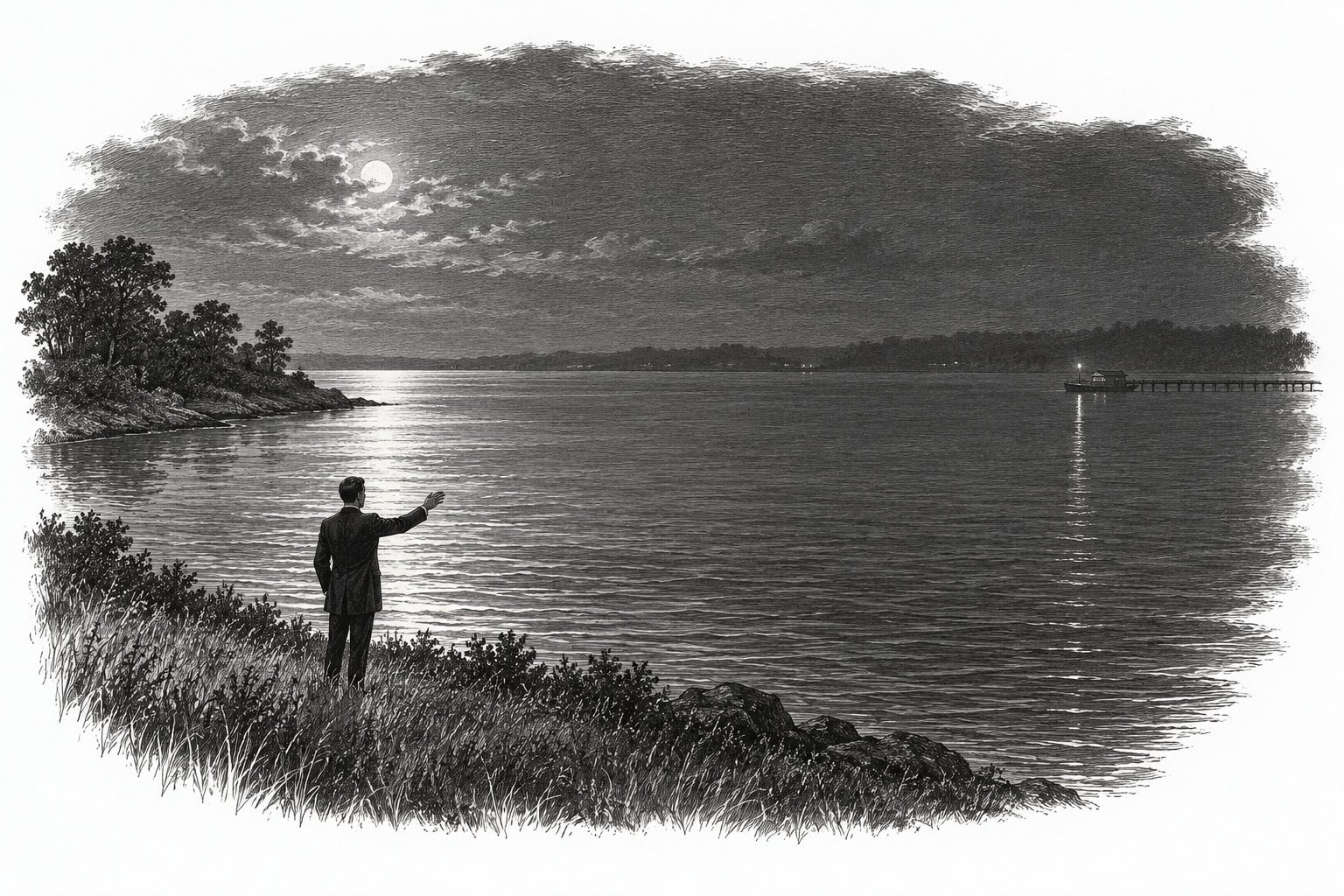
Before the green light becomes a literary symbol, it is something very small: a light at the end of a dock, visible across a stretch of dark water. Fitzgerald lets us encounter it at a distance. We see a man reaching toward it before we understand why he is reaching.
That order matters. The image is compelling before it is explained. It asks us to notice a gesture, a separation, and the intensity of someone else’s attention. Reading the light only as a fixed code for money, hope, or the American dream can make us miss the more unsettling thing the novel does: it changes what the light means as Gatsby moves closer to what he wants.
First, a gesture in the dark
At the end of chapter I, Nick sees Gatsby outside his house, stretching his arms toward the water. Nick follows the direction of that gesture and makes out a distant green light. He does not yet connect it to Daisy Buchanan. For a first-time reader, the scene is therefore a question rather than an answer.
The setting makes longing visible without naming its object. Gatsby has a magnificent house and, as we will discover, the resources to fill it with strangers. Yet the first sustained image of him is solitary. He is not enjoying what he possesses; he is reaching toward something beyond it. The distance across the bay gives a physical shape to the difference between having much and feeling that something essential is still missing.
It is also important that Nick watches from outside. We receive Gatsby’s desire through another person’s perception, not an explanation directly from Gatsby. The novel establishes both the force of the longing and the limits of our access to it.
The light belongs to Daisy’s dock
By chapter V, the light acquires a precise location. Gatsby tells Daisy that her home is across the bay and mentions the green light at the end of her dock. The distant point is not an abstract beacon floating free of the story. It belongs to the geography of their separation.
This specificity makes the image stronger. Gatsby has organized his life around the possibility of reunion. His house faces toward Daisy’s world, and the light offers a repeated, visible connection to it. Something ordinary becomes charged with significance because he looks at it through the history of what he has lost and what he hopes to recover.
The scene also resists treating Daisy as nothing more than a prize. The reader can distinguish between a living person, with a life and choices of her own, and the enormous expectation Gatsby has placed upon her. The light helps us see the expectation; it cannot guarantee that Daisy will fulfill it.
What happens when the distance closes?
The reunion in chapter V produces a surprising change. With Daisy beside Gatsby, Nick imagines that the light has lost some of its former significance. It is again a light on a dock rather than a nearly unreachable object of devotion. Fitzgerald does not simply reward the dreamer by making the symbol brighter at the moment of fulfillment.
One way to read this change is that desire depends partly on distance. From across the bay, Gatsby can invest the light with a future shaped almost entirely by his own imagination. In Daisy’s presence, that future must meet another person and the facts of the present. The practical distance narrows, but the gap between an imagined reunion and a real one remains.
This does not make Gatsby’s feeling insincere. It makes sincerity insufficient. A hope can be deeply felt without being an accurate account of what another person can give, or of what time allows.
A future built from the past
Chapter VI makes Gatsby’s relationship to time especially clear. Nick questions the possibility of repeating the past; Gatsby refuses the limitation. His ambition is not merely to start a new relationship. He wants the intervening years to yield to the life he believes should have happened.
That tension changes how we understand the light. It appears to point forward, toward something not yet attained, but the future it promises is constructed from an earlier moment. Gatsby’s self-invention and material success have not freed him from the past. In this reading, they are tools for trying to recover it.
We need not reduce the image to a single moral about ambition. Fitzgerald allows aspiration to be attractive and destructive at once. Gatsby’s capacity to imagine another life distinguishes him, while his refusal to recognize the limits of that imagined life exposes him to disappointment.
Why the light returns at the end
In chapter IX, Nick returns to the green light as he thinks about Gatsby’s belief in a future that keeps receding. The perspective widens beyond one man’s desire for one woman. Nick links that reaching impulse to a larger experience of imagining fulfillment just ahead, even as the past continues to exert its pull.
The ending does not erase the dock, Daisy, or the particular history of Gatsby’s hope. Those details give the broader reflection its emotional weight. The light can suggest a national promise of possibility because we have already seen the personal cost of pursuing a promise without accepting what resists it.
On a rereading, try following the image through chapters I, V, and IX before deciding what it stands for. Notice who sees it, who explains it, and what has changed each time. The green light endures not because it has one answer attached to it, but because an ordinary object can hold so much of the distance between the life we live and the life we imagine.
Text & reading references
This essay offers an interpretation, grounded in the following passages of Fitzgerald’s 1925 novel. Chapter references are used because pagination varies by edition.
- The Great Gatsby (1925), chapter INick’s first sight of Gatsby reaching toward the bay.
- The Great Gatsby (1925), chapter VDaisy’s dock and the light’s altered significance after the reunion.
- The Great Gatsby (1925), chapter VIGatsby’s insistence on recovering the past.
- The Great Gatsby (1925), chapter IXNick’s closing reflection on the light and the receding future.